Engineering Design and Manufacturing Company Gains Global Opportunities
 SMARTSAT, Inc. of Pinellas County
Nearly 30 years ago, SMARTSAT was founded to solve a critical military communications challenge. Today, the Largo-based company is leveraging support from the Florida SBDC at University of South Florida (USF) to explore new international markets and pursue opportunities with organizations such as the European Space Agency.
Founded by USF Alum, Heidi Akers, SMARTSAT develops satellite simulation technology used by engineers and defense organizations to test and certify communications systems on the ground before deployment. “We’ve been in business now, it’ll be 30 years in December,” said Akers, founder and CEO of SMARTSAT. “We realized that we needed a tool for engineers to do radio and satellite development here on the ground rather than using the live satellites up in space.”
The company’s origins can be traced back to lessons learned during Operation Desert Storm, when military engineers struggled to access limited satellite resources while active operations were underway. “At the time, nobody thought, ‘Goodness, we can take a Nintendo 64 type of product and create an engineering tool that would be effective for engineers to do radio development in a lab,’” Akers said. “The government liked it so much that they decided they would use our tool as a certification tool for radios before they went to live deployment out in the field.”
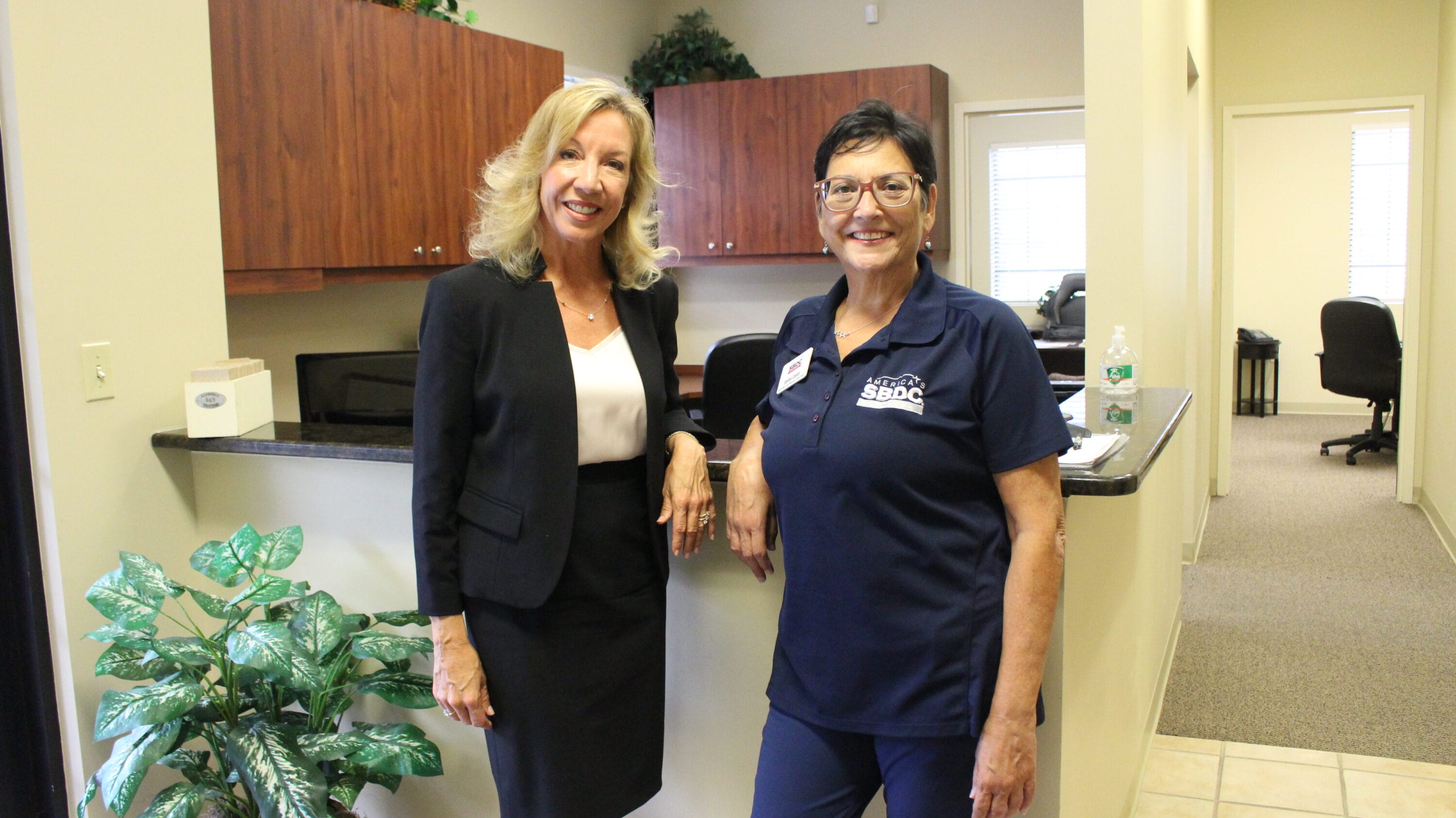
As SMARTSAT continued to grow, Akers sought assistance in identifying new opportunities beyond the company’s traditional markets. A referral from Pinellas County Economic Development connected her with the Florida SBDC at USF and international trade consultant Selma Canas.
Although SMARTSAT had conducted international business for years, its efforts were largely concentrated among the “Five Eyes” nations: the United States, Canada, the United Kingdom, Australia and New Zealand. As more countries began investing in satellite technologies for defense and communications, Akers recognized the need for a broader market strategy. “There’s a difficulty to reach out into the broader community,” she said. “It’s not always easy to look overseas and understand what the market looks like.”
Through the Florida SBDC at USF, SMARTSAT received a customized Export Marketing Plan that provided detailed analysis of international opportunities, potential customers and market trends. “What she produced for our company was something that was actionable,” Akers said. “It showed us who the customers were worldwide, what the need was near term, midterm, long term.”
The plan also helped SMARTSAT better understand emerging opportunities throughout Europe. “The export marketing plan was an outstanding tool for us to better understand what are the countries that are involved, what’s the budget they have allocated, and what is their plan over the next midterm and long term for each of those nations,” she said.
Shortly after receiving the plan, Akers applied for and received funding through the State Trade Expansion Program (STEP), which enabled her to attend GovSatCom, a government and defense satellite communications conference in Luxembourg.
What began as an opportunity to learn more about the European satellite market quickly developed into a significant business prospect. “While standing in the Airbus booth, I was approached by the technical contact at the European Space Agency who said, ‘We need that as a training tool. We need this system in country,’” Akers recalled. That introduction soon led to additional conversations and a referral to a company in Italy.
For Akers, the experience demonstrates the value of business counseling and international trade assistance. “Doing the export marketing plan allowed me to apply for the STEP program,” she said. “The STEP program provided really valuable funds to get to a really important conference over in Europe that, as a small business, might’ve been difficult for me to get to.”
Akers believes she is only beginning to tap into the resources available through the Florida SBDC at USF. As the company plans for future growth, she hopes to explore additional funding opportunities, develop scaling strategies and position the company for long-term sustainability. “I’m only now beginning to understand the breadth and depth of resources that you have at the Florida SBDC,” she said. “Long term, it is every business’ dream to scale.”
Looking back on SMARTSAT’s journey, Akers points to one of the company’s proudest accomplishments: supporting a major military communications program that resulted in the design and manufacture of 455 power amplifiers for the Joint Tactical Terminal system. “We shook sand out of them when they came back in again,” she said. “They had been through some really difficult circumstances, and they worked. That was something that was so satisfying for us.”
Another proud moment was when SMARTSAT responded to a U.S. Government Request for Information (RFI) that was intended for several large defense contractors. Collaborating with a group of small business owners, SMARTSAT developed a response strategy asserting that small businesses could fulfill the government’s requirements with greater speed, higher reliability, and at a much lower cost. “We submitted a proposal, and on July 7, we received the contract award – nearly $1M to retrofit the satellite communications lab at Hanscom Air Force Base in Massachusetts.”
Today, SMARTSAT continues to build on that legacy of innovation while pursuing new international opportunities. Akers credits the Florida SBDC at USF with helping the company navigate unfamiliar territory and prepare for its next chapter. “There is often a tendency among entrepreneurs to think we can do it ourselves,” she said. “The most important thing we do is recognize that we don’t know what we don’t know.”
“It has been wonderful to connect with an organization that has some deep resources and that will allow me, as a small business, to come in and admit I don’t know, and connect me with some other folks who really do and can help us move forward.”